
Understanding Moore County Releases
A release from Moore County custody means the sheriff or another holding agency ended its control under a court order, bond, completed term, transfer, or other authority. It does not always mean the person walked into the community. Someone may leave the Moore County Jail for a Texas Department of Criminal Justice intake unit, another county with a warrant, federal custody, or immigration custody. The sheriff's booking and release transaction identifies the local exit. A receiving agency's record shows whether custody continued.
That distinction explains why a name may vanish from a live roster. A roster describes current custody, not the full history of Moore County released inmates. The durable trail may include the jail transaction, the criminal case, a TDCJ record, or a federal docket. Use the exact name, date of birth when lawfully known, booking date, booking number, and cause number to avoid a same-name match.
- Release
- An exit from one agency's custody, including a transfer.
- Parole
- Conditional prison release authorized by the Texas Board of Pardons and Paroles.
- Probation
- Court-ordered community supervision, which is not parole.
- Discharge
- Completion of the sentence and any attached supervision.
Moore County Release Routes
The record's own release term matters. A bond order may authorize release, but the jail transaction establishes when processing ended. A sentence-complete or time-served entry reflects a different legal basis. Transfers require another search because the person has left Moore County custody without necessarily becoming free.
| Route | Meaning | Next confirmation |
|---|---|---|
| Bond or court order | Local custody ends after authorization and processing | Sheriff release event plus the court file |
| Time served or sentence complete | The county term has ended | Jail time sheet, judgment, and release transaction |
| TDCJ transfer | State prison custody begins | TDCJ inmate information |
| Other warrant or agency | A receiving jail or agency assumes custody | The destination named by the sheriff |
| Federal or ICE pickup | Federal criminal or civil immigration custody may follow | Federal docket, BOP, USMS, or ICE locator |
Dismissal, medical release, escape, and death are possible concepts in jail systems, but the research did not verify Moore County's database labels. Quote the custodian's actual term rather than replacing it with a guess.
Moore County Release Record Fields
The Moore County Sheriff's Office maintains the most direct evidence of a local booking and exit. Ask for an existing record with named fields. The Public Information Act generally gives access to records, not a duty to answer open-ended questions about why an event occurred. Some identifiers, victim data, security material, or active-investigation information may be redacted.
| Requested field | What it establishes |
|---|---|
| Booking number and time | The correct custody episode |
| Arresting agency and charge | How the booking began |
| Bond and court data | The linked order and cause |
| Release date and time | When sheriff custody ended |
| Release authority or type | The recorded basis for the exit |
| Destination or transfer code | Whether another agency received the person |
A booking photograph proves only that an image was made during booking. A bond amount proves only what was set at that point. Neither proves release. Pair the release flag or transaction with its event time and destination, then compare it with the court order when the legal reason matters.
Request Moore County Release Records
Moore County does not publish a verified release archive or request fee online. The official route begins with the Moore County Sheriff's Office at 700 S. Bliss Avenue, Dumas, Texas 79029, office phone 806-935-4145. Ask which channel accepts a written Public Information Act request and request electronic copies when available. Routine records questions belong on the office line, not emergency dispatch.
- Identify the person, approximate booking span, and booking or cause number.
- Describe the existing booking and release record and list the fields needed.
- Ask for the standard release report if a custom date export would require new programming.
- Accept lawful redactions and request a written cost estimate before chargeable work.
- Follow any transfer destination with the receiving agency.
Texas law requires production as promptly as possible under the circumstances. It does not promise a universal ten-business-day delivery date.
No official Moore County page states how long a past booking remains visible because no public sheriff archive was found. Absence online is not proof that the underlying record was destroyed.
Texas Law on Moore Releases
Texas Government Code Chapter 552, the Public Information Act, governs requests to the sheriff and other state or local bodies. Exceptions can protect specific information, and an agency may seek an Attorney General decision when withholding is disputed. The Attorney General's public-information resources explain request and cost procedures.
Expunction under Code of Criminal Procedure Chapter 55A can require covered records to be destroyed or returned. Nondisclosure under Government Code Chapter 411 limits ordinary disclosure of covered criminal-history information but is not the same as destruction. Juvenile and victim records have separate protections. A missing result alone does not prove that any order was entered.
Two Moore Release Record Stops
Moore County's release trail is split between two nearby offices in Dumas. The sheriff at 700 S. Bliss Avenue keeps the booking and release transaction. Court custodians at the Moore County Courthouse, 715 S. Dumas Avenue, keep the filed order, judgment, sentence, and later supervision documents. The jail event proves physical exit time and destination. The clerk file explains the legal authority.
District felony records generally route through the Moore County District Clerk, Room 109, phone 806-935-4218. County-level matters may route through the County Clerk, Room 107, at 806-935-2009 or 806-935-6164. A docket date is a schedule, not a release record. Use the cause number to request the filed order.
Moore County Bond Release Proof
A bond order and posting record explain why release was permitted. They do not prove that identity checks, holds, property steps, and the jail's exit transaction were complete. Moore County publishes no verified bond schedule or release-processing time, so a promise that someone will leave within a generic number of hours would be unsupported.
Use the court cause number and sheriff booking number together. The court record establishes the bond authority. The sheriff record supplies the actual release time and destination. If a hold or warrant caused a transfer, the receiving record completes the custody chain.
Find Released Moore County Inmates
Start with the last confirmed custodian. Moore County has no official person-level roster or recent-release feed on the reviewed sheriff page, so the search must combine VINE, a direct inquiry, records, and court files. A wider search becomes necessary when the release event says transfer.
- Collect the exact name, birth date if known, booking span, arresting agency, and cause number.
- Open the sheriff's official page and follow its VINELink referral for Texas and the relevant agency.
- Call the sheriff office and ask whether Moore County custody continues and which public record identifies an exit.
- Request the booking and release transaction when a phone check is not enough.
- Search the correct Moore County clerk for the order, judgment, or disposition.
- Follow a TDCJ, county, USMS, BOP, or ICE destination in that system.
Leaving a Moore County display is only a clue. Confirm the exit event and destination before calling it a community release.
Texas Search for Moore Releases
The TDCJ Online Inmate Search covers people currently sentenced to and incarcerated in state prison, not ordinary Moore County pretrial custody or a county-only sentence. Prefer a seven-digit TDCJ number or SID. A name search can be narrowed by the matching fields presented by the official form. Compare identity, offense, county, and sentence data before opening a result.
| Field | Use | Limit |
|---|---|---|
| TDCJ number | Best direct identifier | Applies only after a TDCJ record exists |
| SID number | Texas identity match | Must be entered accurately |
| First and last name | Broader search | Same-name risk |
| Gender and race | Interface matching aids | Use only as recorded aids, not assumptions |
The online tool says its data is at least 24 hours old and updated on working days. It does not promise a complete former-inmate archive. If no current result appears, use the TDCJ email information route or published phone service for releasable history, release type, discharge date, and supervision status.
The official TDCJ search form shows both its identifier fields and current-custody scope.
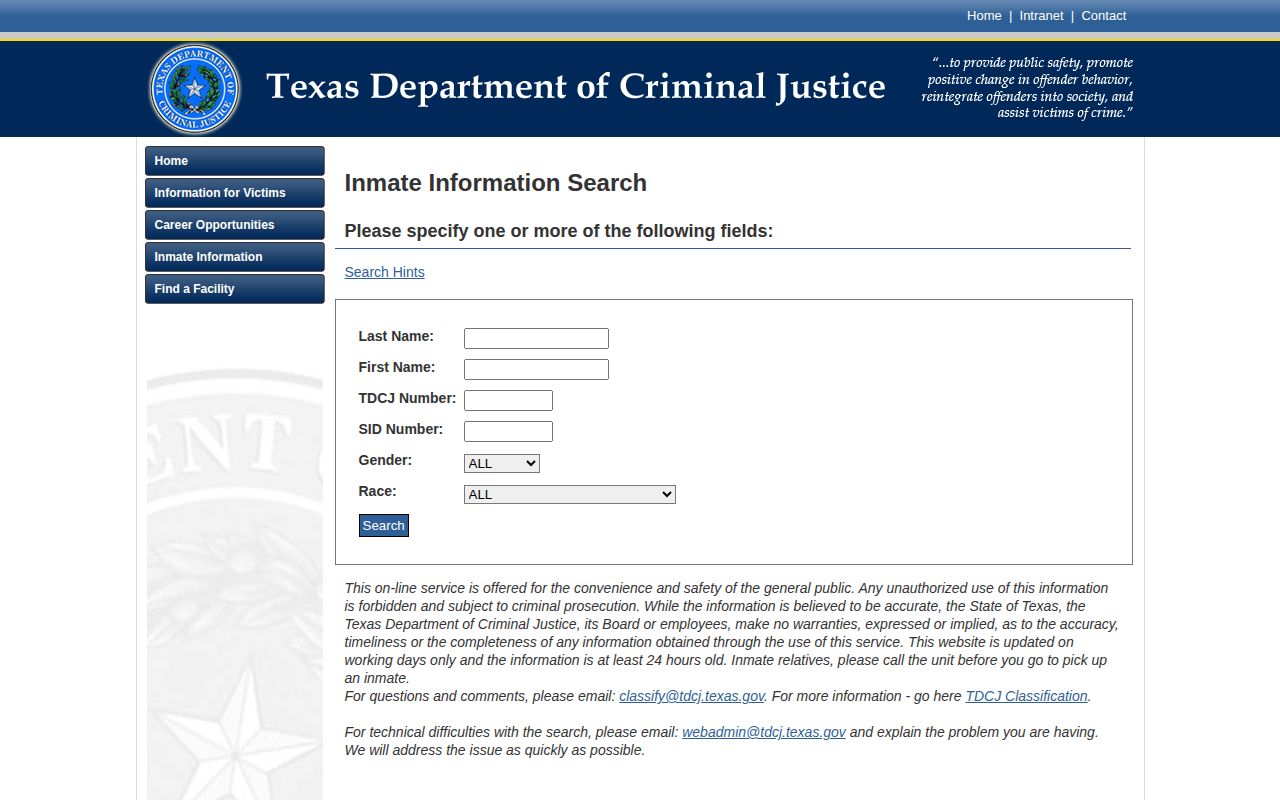
That scope warning is why an absent result must lead to the historical email, phone, court, and supervision channels.
Moore County Recent Release Records
The reviewed sheriff page offers office contacts and VINELink but no county-hosted 24-hour list, 72-hour list, archive, app, or mugshot gallery. It also publishes no update cadence or retention rule. For a date-bounded list, request release-log entries between exact Central Time timestamps and ask for booking number, name, booking time, release time, public release authority, charge and bond fields, and destination.
A three-day span is useful across weekends and holidays, while a one-day span answers a narrower activity question. In either case, transfers must not be counted as community freedom without checking the receiving agency. VINELink may lag the source system, and a signed record may arrive later but provide stronger evidence.
Moore Release Supervision Records
Parole and mandatory supervision follow a Texas prison release. BPP makes the decision, while the TDCJ Parole Division supervises the releasee. Probation is imposed through the trial court and handled by the regional community-supervision department. A person with a county-only probation case may never appear in the state prison search.
Moore County's 69th Judicial District CSCD serves several Panhandle counties. State parole office assignment follows the approved residence and current directory, not merely the county named in the conviction. Verify the judgment and CSCD record for probation, or TDCJ and BPP records for parole. A discharge order or TDCJ discharge date marks a different endpoint from release into supervision.
Correct Moore Release Record Errors
Send a correction to the office that created the disputed layer. The sheriff controls the booking or release transaction and any booking image. A clerk or court controls the docket, judgment, and filed order. TDCJ Classification and Records handles state time calculations, while BPP and the Parole Division control decision and supervision data.
This division prevents a common dead end. A court clerk cannot change a jail exit timestamp, and the sheriff cannot revise a judgment. Preserve the record, state the exact field in dispute, attach the correct source when permitted, and keep the response from the responsible custodian.
Moore Federal and ICE Releases
VINELink is the county-endorsed custody-status and notification route, but it is a relay and not a guaranteed real-time archive. Search the actual Texas jurisdiction and Moore agency. TDCJ's Integrated Victim Services System is separate and covers state custody and parole notifications within its own rules.
For a sentenced federal prisoner, the BOP Inmate Locator may show a release date or that the person is not in BOP custody. A recent USMS detainee may not appear there, so use the federal docket and USMS prisoner route. ICE's Online Detainee Locator requires an A-number and country of birth or biographical fields. No result can reflect release, transfer, removal, delay, or ineligible locator coverage.
Confirm Moore County Texas Records
TDCJ operates the Choice Moore Unit in Fannin County. It is not a prison in Moore County. Search results also mix Moore Counties from other states. Pair every local search with Texas and Dumas, and use the TDCJ Unit Directory before treating a similarly named unit as a local facility.
Agency identity matters as much as a matching name. A Moore County sheriff transaction concerns local jail custody in Dumas. A TDCJ result concerns a state sentence and a unit assigned somewhere in Texas. BOP and ICE records belong to separate federal systems. Record the agency, jurisdiction, identifier, status wording, and date checked with each result. Those details prevent an unrelated Choice Moore Unit record, another state's Moore County, or a transfer between custodians from being mistaken for a local community release.
Use the destination field to continue the search. A transfer to TDCJ calls for the state inmate-information channels. A federal destination calls for the federal docket, USMS inquiry, or BOP locator according to the stage of the case. An immigration destination calls for ICE's locator and ERO route. If the sheriff record instead documents a community exit, the filed court order explains the authority while the jail transaction proves when local custody actually ended.
A reliable Moore County chronology may require more than one document. Keep the sheriff booking number beside the court cause number, but do not treat them as interchangeable. The booking record answers who held the person and when that custody ended. The court file answers what order authorized bond, dismissal, sentence, or supervision. A receiving-agency identifier then carries the trail forward after a transfer. When sources disagree, ask the creator of the disputed field to review its own record. The clerk cannot alter a jail timestamp, and the sheriff cannot rewrite a judgment or a TDCJ calculation.
“Moore County inmate” can describe a booking, residence, conviction, or family connection. It does not establish present location. The agency named in the latest verified transaction controls the next search.
Compare Moore Custody and Release
Each official channel answers a limited question. Use several when the path crosses systems.
| Channel | Best answer | What it cannot prove alone |
|---|---|---|
| Sheriff or VINELink | County custody status or relayed event | Freedom after a transfer |
| County release transaction | Exit time, authority, destination | Later custody elsewhere |
| Court file | Bond, dismissal, judgment, sentence | Physical exit time |
| TDCJ | State custody, projection, parole or discharge data | County-only detention |
| BOP, federal docket, or ICE | Federal or immigration custody trail | Unrelated Texas custody |
The Texas DPS registry applies only when registration law requires it. It can show a person in the community but is not a general list of released Moore County inmates.
Moore County Release Facilities
The Moore County Jail is the main local detention facility. Dumas, Cactus, and Sunray police departments are arrest or short-hold nodes unless a record proves a county booking. TDCJ placements occur statewide. No local BOP or ICE facility was verified, so federal and immigration claims must follow the named case record.
- Moore County Jail: confirm direct release or transfer with the sheriff record.
- Dumas, Cactus, and Sunray police: identify which facility accepted continued custody.
- Texas Department of Criminal Justice: use statewide inmate, records, and parole channels.
- Federal and ICE systems: use the locator and docket tied to the actual case.
Facility names and destinations should come from official records, not directory pages. A transfer from the Moore County Jail ends county custody but begins the next verification step.