
Moore County Projected Versus Actual Release
Four dates are often mistaken for one. Parole eligibility is only the first date on which the law permits consideration. A TDCJ projected release date is a Classification and Records estimate under the rules for a state sentence. A scheduled date is operational and follows authority and processing. Maximum expiration or discharge is the sentence endpoint calculation.
A Moore County pretrial detainee has no sentence-based release date. Bond, dismissal, a court order, or case resolution controls the next event. Even for a sentenced person, a projection does not prove the person walked out that day. The releasing agency's transaction supplies the actual time and destination.
Find a Moore County Inmate Release Date
First determine whether the person remains in Moore County Jail, entered TDCJ, or moved to another agency. Do not apply a state prison projection to a county case that never entered TDCJ.
- Obtain the cause number, judgment, sentence, and credited confinement from the proper Moore County clerk.
- For a county sentence, request the jail time sheet, locally applied credit, holds, and release transaction from the sheriff.
- For a state prisoner, use the TDCJ Online Inmate Search. Last name is required; first name, TDCJ number, SID number, gender, and race may narrow it.
- If the online record is unclear, use the TDCJ email channel with the required identity details.
- Confirm near the date with the current custodian and check the receiving system if the event is a transfer.
TDCJ describes its online data as information about people currently sentenced to and incarcerated in TDCJ. It is not a complete Moore County release archive. The email and telephone access channel provide official fallbacks.
Texas Credit Shapes Moore County Dates
Government Code Chapter 498 governs TDCJ good-conduct time. It authorizes classification-based credits that can be forfeited. Good time is a privilege and does not erase part of the judicial sentence.
Texas has no universal rule requiring every state prisoner to serve 85 percent. Chapter 508 contains different parole formulas. Some listed serious-offense or deadly-weapon cases generally use actual calendar time equal to one-half of the term or 30 years, whichever is less, with a statutory minimum. Other formulas use calendar time plus good time. Offense date matters.
Many eligible cases with later offense dates receive discretionary mandatory-supervision review. The board may deny release under the statutory findings, and TDCJ can recalculate the projection to maximum expiration. Eligibility does not guarantee release.
Why Moore County Release Dates Move
A lawful calculation can change as the record changes. Compare the source and update time before treating a move as an error.
| Change | Effect |
|---|---|
| Judgment or jail-credit correction | Changes the sentence basis or credited time |
| Good-time loss or restoration | Moves an applicable TDCJ projection |
| Detainer, warrant, or new sentence | May block community release or cause transfer |
| BPP vote | May approve, deny, defer, or add requirements |
| Program or residence plan | Can delay operational scheduling |
A favorable parole vote can still require a program, approved plan, certificate, detainer resolution, and record audit. It is not proof of physical freedom.
Confirm Moore County Release Timing
The Moore County sheriff refers custody-status users to VINELink. An alert can help track an agency event, but it can lag and is not a legal guarantee. The VINELink release check explains how to match one person and register.
TDCJ IVSS is a separate state-prison and parole notification layer. Neither service replaces direct confirmation. Ask whether the event was community release or transfer to TDCJ, another jail, federal custody, or ICE custody.
Near the expected date, confirm status, authority, destination, and the completed transaction with the custodian. “Not here” is not the same as discharged.
Moore County Jail Date Calculation
No Moore County-specific good-time table, weekend-release policy, or public calculator was found. TDCJ's Projected Release Date should not be imported into a local sentence merely because both records use the word release.
A county sentence starts with the judgment, sentence start, and credit for confinement. Multiple cases, concurrent or consecutive terms, holds, locally authorized credits, discipline, and later orders can alter it. Code of Criminal Procedure Chapter 43 contains county-jail discharge provisions, but the actual file controls.
Request the judgment, jail time sheet, release transaction, and each applied credit. Ask for existing records rather than a custom prediction.
Read Texas Release Date Labels
The TDCJ definitions page distinguishes projected release, discharge, parole, mandatory supervision, maximum expiration, and serve-all. Each answers a different question.
The official TDCJ definitions screen below anchors those terms in the state system.
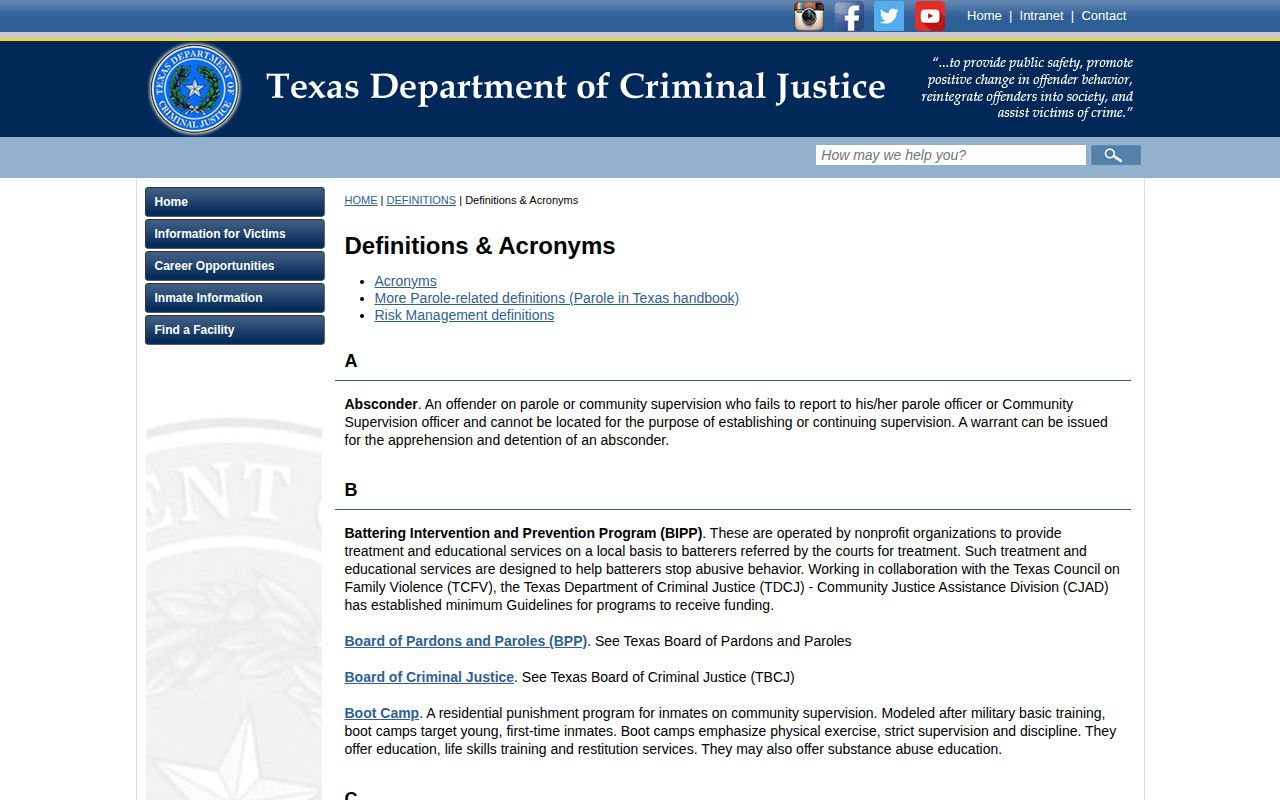
The image does not calculate a Moore County jail term or confirm an actual exit.
TDCJ Fields for Moore County Dates
The state search requires a last name. First name, TDCJ number, SID number, gender, and race can narrow a match. An applicable detail record may show current location, offense and sentence data, projected release, and parole eligibility. Availability depends on the record and current interface.
| Field | Use | Limit |
|---|---|---|
| Last name | Required input | May return several people |
| TDCJ or SID number | Strong identity match | May be unknown |
| Projected release | State calculation | Not an actual exit |
| Parole eligibility | Earliest consideration | Not approval |
| Current unit | State custodian | Can change |
If a former prisoner no longer appears, send an email request or seek releasable historical information from TDCJ Classification and Records. Include the birth date or approximate age and county of conviction when the TDCJ number is unknown.
The official request screen shows the needed identifiers and projected-release explanation. Review TDCJ inmate information by email.
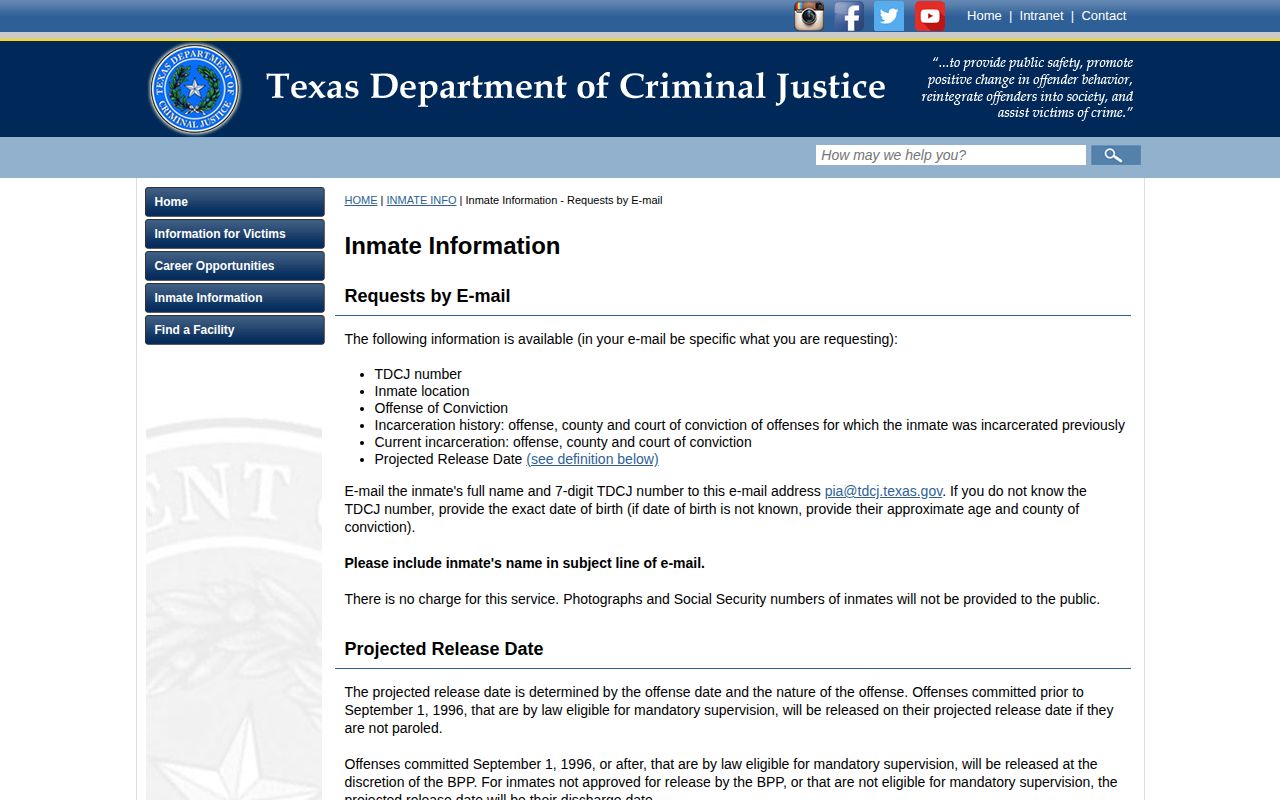
TDCJ states that this channel is free. It supplies information, not a guarantee that a scheduled event will occur unchanged.
Moore County Holds Change Release
A hold or detainer gives another authority a basis to take custody. It can prevent community release even when the first agency has finished its own case. A Moore County record may therefore show release from county custody while the person is transported to TDCJ, another county, federal custody, or immigration custody.
Ask the custodian for the release destination and transfer authority, then check the receiving system. TDCJ covers state prison sentences. The BOP locator addresses covered federal sentenced prisoners, while many federal pretrial detainees remain in U.S. Marshals contract custody. ICE uses its own locator.
A no-result is not proof of freedom. Name variants, data delay, locator eligibility, or movement between systems can explain it. Court dockets show legal authority, but a docket date does not prove physical movement occurred that day.
Parole Alters Moore County Projections
The Texas Board of Pardons and Paroles makes parole and discretionary mandatory-supervision decisions. Eligibility permits review only. A favorable vote can still require a program, acceptable residence plan, release certificate, detainer resolution, and final audit.
Section 508.145 supplies different formulas. Certain cases use actual calendar time, while other provisions can use calendar time plus good time. Mandatory-supervision exclusions appear in Section 508.149, and Section 508.1491 addresses discretionary review. Offense date and the applicable law must be known.
If the board denies discretionary mandatory supervision, TDCJ may move the projection to maximum expiration. That reflects a later legal decision rather than proof the earlier calculation was false.
Moore County Date Record Set
A county calculation needs more than an arrest date and sentence length. Request the judgment, sentence start, credited confinement, jail time sheet, applied credits, active holds, and completed release transaction. List every known cause because multiple cases may run together or one after another.
Ask for records the sheriff and clerk already maintain. The Texas Public Information Act allows clarification and authorized costs, and exceptions can require redaction. It does not require an office to create a legal prediction.
When records conflict, ask the creator of the disputed field. The clerk handles judgments. The sheriff handles its jail computation and exit. TDCJ Classification and Records handles state dates. BPP handles its decision. Keeping those layers separate produces a sound Moore County answer.
Note: Record the source and check date because an older release-date screenshot may no longer match the active calculation.
Moore County Courts Set the Base
The criminal judgment starts a sentenced person's time line. It identifies the sentence and may address credit for confinement. A docket can show amended orders, revocation, dismissal, bond, or another event that changes why the person remains held. Obtain the document from the clerk responsible for the case rather than relying on a calendar entry alone.
For probation, a court may order community supervision and a county jail period as a condition. The physical jail exit and the supervision term remain separate records. For a state sentence, Moore County Jail may transfer the person to TDCJ. That transfer ends local custody but is not community release, and the state system then owns the prison calculation.
If the judgment changes, give the amended order to the agency computing time and ask for its updated existing record. The clerk cannot change a sheriff timestamp, and the sheriff cannot rewrite a judgment. Each custodian corrects its own layer.
Prove the Moore County Exit
The completed release transaction is the best record of leaving Moore County custody. Ask for the date, time, authority, and destination fields that exist and are public. A bond posting can show legal authority, but it does not prove jail processing ended at that moment.
No official Moore County processing duration or weekend policy was found. Avoid generic promises about how many hours a bond-out takes. Verification, other holds, transport, staffing, and court paperwork can affect the event.
When the destination is another custodian, confirm receipt there. When it is the community, a VINELink status change can help, but the sheriff transaction remains direct local proof. The actual release date belongs to the completed event, not the prior estimate.
Recheck Moore County Release Dates
A projection becomes more useful as the source, identity, and update date become clear, but it never becomes a completed exit record. Recheck TDCJ or the Moore County custodian close to the expected event. Ask whether authority has issued, whether any hold remains, and whether transport or release processing is complete.
Keep the exact label used by the agency. Projected release, scheduled release, parole eligibility, maximum expiration, discharge, and out of custody do not mean the same thing. A brief dated record of the response makes later changes easier to trace.
For a state case, compare the online detail with the email or telephone response when timing matters. For a county case, compare the judgment with the jail time sheet. If release becomes a transfer, switch to the receiving locator rather than continuing to treat the local date as a community exit.